

Image: ln24SA
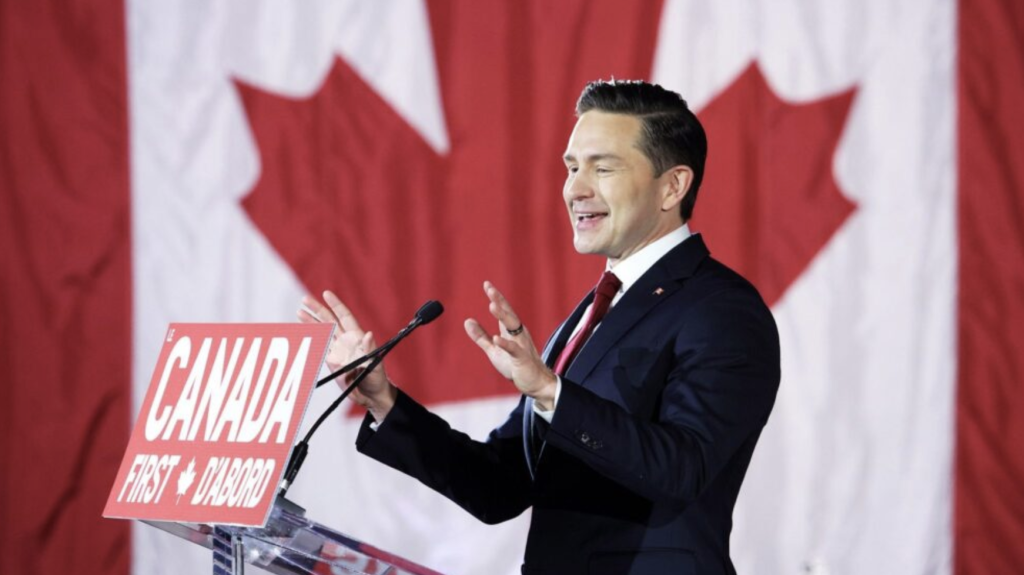
Conservative leader Pierre Poilievre made a bold appearance at a rally held at a union hall just north of Toronto, with Canadian country music blasting in the background.
“Who is ready for change in Canada?!” he shouted, energizing the crowd.
Poilievre, a seasoned 45-year-old politician, reminisced about the 1970s when, he claimed, Canadians could pay off a mortgage in seven years—far faster than the many decades it now takes in certain cities.
While the Conservative Party had a 20-point lead in the polls just months ago, they are now expected to lose Monday’s election to Prime Minister Mark Carney’s Liberals, largely due to Carney’s critical stance on U.S. President Donald Trump.
However, Poilievre’s emphasis on the cost of living has resonated with younger voters, particularly men. A recent poll by Nanos on April 24 revealed that 49.3% of voters aged 18-34 favored the Conservatives, while only 30% supported the Liberals. Among all age groups, the Liberals still led 42.9% to 39.3%. The poll also showed that 45.5% of men, across all ages, preferred the Conservatives compared to 36.7% for the Liberals.
Conducted from April 21 to 23, the survey included 1,307 Canadians and has a margin of error of ±2.7%, 19 times out of 20.
For younger Canadians, Poilievre symbolizes a change from nearly a decade of Liberal leadership under Justin Trudeau, which Poilievre often criticizes as a “lost decade.” Their main concerns are financial—how to afford housing and living expenses, rather than international relations.
Carney, who took office in March, has distanced himself from Trudeau’s policies.
“I’ve been through the struggle of paying for groceries, covering bills, and trying to save up to start a family,” said Joshua Dwyer, 24, a journalism student at Toronto Metropolitan University, who was attending his third Poilievre rally. “It doesn’t work under the Liberal government. We’ve had a decade to try, and it’s not working.”
Polls have tightened in recent days, and Poilievre has been drawing large crowds. Although such rallies and voter intentions do not always translate to election victories under Canada’s electoral system, turnout among young voters, especially in Ontario and Quebec, could be crucial. The youth vote could determine if Poilievre pulls off a surprise victory or if the Liberals secure a majority, potentially relying on support from other parties. Historically, young people are less likely to vote. To engage them, Conservative youth TikTok accounts are encouraging younger conservatives to convince their parents to vote for Poilievre.
The Liberals have tried to draw comparisons between Trump’s populist style and Poilievre’s approach, which includes proposals to cut government funding for the Canadian Broadcasting Corporation and dismantle homeless camps in urban areas. Additionally, Poilievre’s campaign has kept a low profile on Trump, mentioning him only once during his Vaughan rally.
Poilievre’s campaign did not respond to a request for comment.
Both Carney and Poilievre have made housing a central issue, with each advocating for the removal of the federal sales tax on new homes. Poilievre’s approach has garnered support from some voters, like Cameron Pinto, a 24-year-old paramedic student at the rally. Pinto expressed more confidence in Poilievre’s stance, believing less government intervention would allow the private sector to drive new housing developments.
“I’m here because I believe the mismanagement over the past 10 years has caused a lot of the issues we face now,” said Pinto.
Carney, 60, brings a wealth of experience from his time managing central banks in Canada and the UK during the 2008 financial crisis and Brexit—events that occurred when many Gen Z voters were still children.
Young Canadians’ frustration mirrors similar trends seen in the United States and Europe, where younger generations have also leaned towards Conservative politics in recent years.
“There’s a sense among young adults that the opportunities their parents had are no longer available to them,” said Paul Thomas, emeritus professor of political studies at the University of Manitoba.
Whether this shift will have lasting significance is still uncertain, according to Thomas. “They haven’t developed the voting habits of older generations, who see it as more of a duty.”
Get the latests of our Loveworld News from our Johannesburg Stations and News Station South Africa, LN24 International
Related Posts
Some description text for this item