Image: ln24SA
Russia calls for multipolar leadership as BRICS nations push for deeper global influence
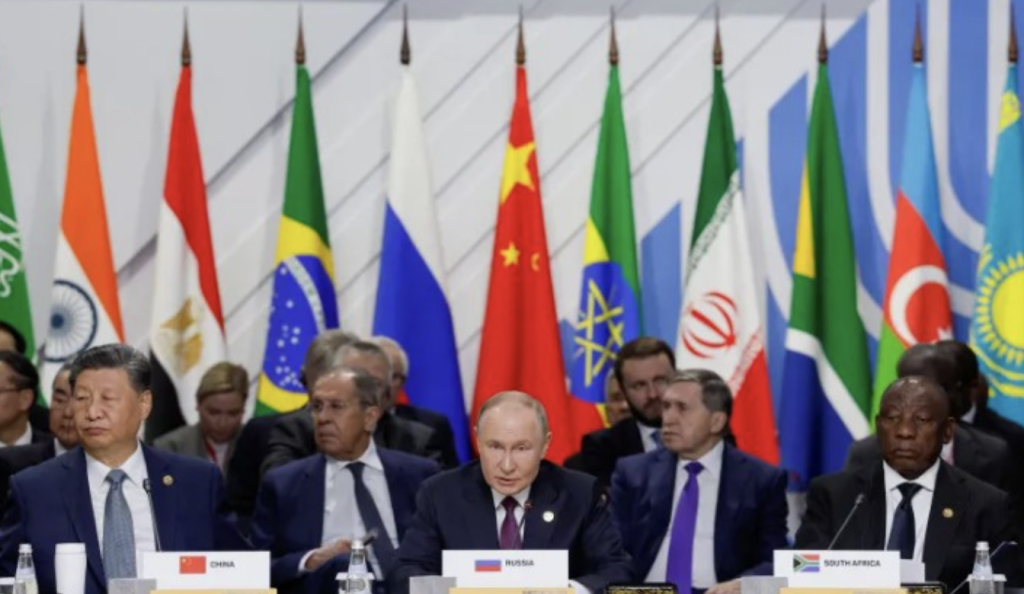
At the 2025 BRICS Summit, Russian President Vladimir Putin issued a sharp rebuke of the current Western-dominated global order, declaring it “obsolete” and out of step with the 21st-century balance of power. Putin championed a multipolar international system and praised BRICS as the future engine of equitable global governance.
“The unipolar world that emerged after the Cold War has proven ineffective, unjust, and increasingly destabilizing,” Putin said. “BRICS offers a new foundation based on mutual respect, sovereign equality, and shared progress.”
BRICS 2025: A Shift in Global Power?
The BRICS bloc comprising Brazil, Russia, India, China, South Africa, and newly admitted Egypt, Saudi Arabia, Iran, and the UAE has grown in geopolitical and economic influence. This year’s summit centers around themes of global reform, de-dollarization, economic development, and digital transformation.
Putin’s remarks signal Russia’s continued effort to align itself with non-Western powers amid ongoing tensions with the United States and European Union, especially after the Ukraine war and subsequent sanctions.
“We are building a system where power is no longer monopolized by a few nations,” Putin said, “but shared among responsible players committed to fairness and development.”
Multipolarity vs. Western Dominance
In his speech, the Russian president criticized the West for double standards, accusing NATO and the G7 of destabilizing sovereign nations and weaponizing financial institutions. He cited growing frustration among Global South nations, many of whom see BRICS as a credible alternative to Western influence.
“Sanctions, interventions, and financial coercion cannot be the pillars of a just world order,” Putin added.
Chinese President Xi Jinping, Indian Prime Minister Narendra Modi, and South African President Cyril Ramaphosa echoed calls for greater equity in global institutions like the United Nations, IMF, and World Bank, many of which are still heavily influenced by the U.S. and its allies.
Economic Cooperation and Strategic Goals
Beyond politics, BRICS leaders are focusing on tangible projects:
A proposed BRICS digital currency
Cross-border payment systems bypassing the U.S. dollar
Joint infrastructure and energy investment projects
Expansion of the BRICS Bank (NDB) to finance development in the Global South
“Our shared goal is not confrontation but cooperation,” said Brazil’s President Luiz Inácio Lula da Silva. “BRICS is not anti-West; it is pro-global balance.”
Global Reactions and Future Outlook
Western governments have largely dismissed BRICS rhetoric as symbolic, though analysts acknowledge the bloc’s growing clout. The combined GDP of BRICS+ nations now surpasses that of the G7 when adjusted for purchasing power parity (PPP), and their share of global energy reserves and agricultural exports continues to rise.
Critics argue that deep divisions within BRICS such as India-China border tensions and differing political systems could hamper its ambitions. However, the BRICS 2025 Summit reflects a clear intention: reshape the world’s rules to better reflect the emerging multipolar reality.
Conclusion
Putin’s declaration at the BRICS Summit adds to the mounting discourse challenging long-standing Western dominance in global affairs. Whether BRICS can translate ambition into action remains uncertain but its leaders are clearly staking a claim in what they call the “post-Western era.”
Get the latests of our Loveworld News from our Johannesburg Stations and News Station South Africa, LN24 International