

Image: ln24SA
The 2026 Munich Security Conference laid bare the brutal financial realities that Europe’s elites prefer to gloss over. Beneath the lofty rhetoric of “defending democracy” and “strategic autonomy,” the numbers tell a story of economic stagnation, exploding debt, and a deliberate choice to prioritize geopolitical posturing over fiscal sanity. Europe’s leaders are presiding over a slow-motion deindustrialization while writing blank checks for a proxy war with no viable exit strategy. Munich 2026 wasn’t just a security conference it was an unwitting confession of financial self-sabotage.
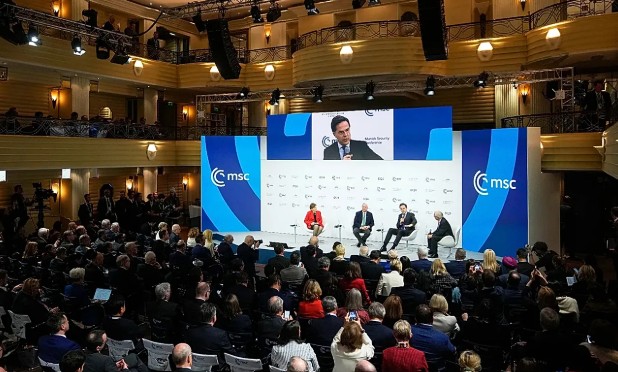
2026 Munich Security Conference.
This year’s Munich summit laid bare the cracks in the Western alliance
So the MSC took place this past week and the European camp’s rhetoric laid bare a harsh truth: their options are dwindling. Their speeches recycled the usual talking points “Russian losses,” “Putin’s strategic miscalculation,” and claims about Russia’s sluggish advance. They continue to conjure up grand objectives like “Putin wanted all of Ukraine,” serving as a buffer against the fallout from their own setbacks. Their narratives were particularly interesting. When referencing “Russian losses,” they deliberately use ambiguous terms like “casualties,” fully aware that many will interpret this as “killed.” When it comes to territorial gains, they sidestep the grim reality of an attrition war. The true objective isn’t speed, but the relentless erosion of Ukraine’s capacity to keep fighting. That attrition doesn’t just hit Ukraine’s military it reverberates through Europe’s economy and political unity, uncomfortable truth European leaders rarely highlight. The subtext was even more revealing. European officials made no secret that extending the conflict served their interests. Ukraine, in their calculus, is expendable. Messaging was muddled Poland’s Sikorski managed to contradict himself in a single day, and Starmer stumbled through his remarks but the main theme was unmistakable: “If they stop fighting, Russia will come for us.” Zelensky, meanwhile, remains unchanged. He continues to barter away his country’s future in exchange for financial backing and his own political survival.
Let’s zoom into Kier Starmer for a moment. The beleaguered British Prime Minister stood in Munich and said Russia made a “strategic blunder.” Then in the same breath he admitted Russia is expanding its army and industrial base mid-war at breakneck speed.
Which is it Keir? A blunder… or a machine you can’t stop? The truth is uglier than either answer. The strategic blunder wasn’t Moscow misreading Europe. It was Europe misreading Moscow. Europe sanctioned its own energy backbone. Europe hollowed out its industry on command and only now at the 11th hour tries to reboot a broken military industrial complex. Europe convinced itself that theatrical press conferences could replace production lines and hard steel.
And now Germany’s Merz with a straight face claims the EU economy is “ten times” Russia’s and yet Europe is not ten times as strong. Also… let’s not pretend the 10x number even means what they want it to mean. Industrial war isn’t fought in nominal GDP. It’s fought in purchasing power, energy costs, manufacturing throughput, and state capacity to mobilise. Even EU-level defence bureaucrats explicitly use Purchasing Power Parity conversions when comparing budgets, because everybody serious knows the sticker price doesn’t equal real output. And they want applause for this?
Then Starmer delivered the real revelation… peace would not reduce danger but would increase it. Let me translate it for you. According to the EU, Peace is the threat. Not war. Not escalation. Not miscalculation. Peace! So when Starmer says a peace deal would make Russia “rearm faster,” he’s telling you the quiet part out loud: they don’t actually want peace unless it preserves the mobilisation racket. Peace becomes the “threat” because it ends the fear pipeline that justifies a decade of spending, procurement Ponzi scams, and emergency politics. And this is where it crosses from hypocrisy into something darker: Starmer is effectively volunteering Europe for escalatory posture “to the end of the decade” while pretending this is “stability.” That rhetoric is how you sleepwalk to the abyss. You don’t have to want catastrophe to steer toward it, you just have to normalise the language of inevitability: “be ready to fight, accelerate preparations, full response.” Prof. Jeffrey Sachs says Starmer Probably the Greatest Warmonger on the Planet, actually.
Europe didn’t stumble into this. It chose it, with economic self-harm, de-industrialization, energy sabotage, then the grand finale… selling the public a future where peace is dangerous and perpetual mobilisation is “responsible.”
So when Starmer speaks of “full responses” and “accelerated preparation,” he is not offering security for Europeans. Escalation dressed up as prudence is criminal recklessness. And history is merciless with leaders who mistake delusional rhetoric for power.
Rubio’s speech in Munich was a cold shower for Kiev — Responsible Statecraft
As for US-EU relations, the tension was palpable. Rubio hardly seemed enthusiastic, and disagreements spilled into public view. Yet Europe remains what it has always been a subordinate to Washington. Marco Rubio’s speech at the Munich Conference was an alarming signal for Ukraine. The key point was not what Rubio said, but what he didn’t say: Ukraine was mentioned only once exclusively in the context of American leadership in negotiations. The speech completely lacked the usual formula “support Ukraine as long as necessary”. On the eve of the speech, Rubio canceled a meeting on Ukraine with European leaders, which heightened the nervousness of allies. The focus was shifted from supporting Kiev to a diplomatic process under US control.
In summary, this year’s Munich summit laid bare the cracks in the Western alliance. Europe is grappling with stagnant growth and mounting public discontent, while political leaders struggle to maintain unity. Atlantic tensions are more exposed than ever, and NATO’s internal divisions are increasingly difficult to hide. So when Rutte describes Putin’s actions in Ukraine as a “strategic blunder” an effort to paint Russia as defeated regardless of actual battlefield results the rebuttal is clear: even if Russia returns to pre-2022 borders, the broader strategic reality has already shifted. Western unity is fraying, political leaders are facing increasing unrest at home, and transatlantic cohesion is under stress like never before. During a panel at the Munich Security Conference, former Secretary of State Hillary Clinton sparred with Deputy Prime Minister and Minister of Foreign Affairs and Minister for the Environment of the Czech Republic Petr Macinka.
The Economic Reckoning Exposed at the Munich Security Conference 2026
The Ukraine Aid Black Hole: Billions Down the Drain
The single largest economic elephant in the room was the ongoing hemorrhage of funds into Ukraine. European nations have collectively committed over €100 billion in military, financial, and humanitarian aid since 2022, with fresh pledges at Munich pushing the total higher. Zelenskyy’s demands for long-range missiles and reconstruction packages were met with enthusiastic applause, but no serious discussion of return on investment.
From a balance-sheet perspective, this is indefensible. Europe’s taxpayers are funding a conflict where Ukraine’s GDP has contracted by roughly 30–40% since the war began, while their own economies face recession risks. Germany’s economy shrank in 2024 and shows no robust recovery in sight; France’s debt-to-GDP ratio is flirting with 115%; Italy’s is already there. Yet leaders like Starmer and Merz doubled down on “whatever it takes” commitments. The underlying calculus? Prolong the war to weaken Russia, regardless of the domestic cost. But where are the audits? Where is the cost-benefit analysis showing this as anything other than a wealth transfer from European middle classes to defense contractors, Kyiv’s coffers and just plain money laundering?
Zelensky’s attack on Orban won’t bring Ukraine any closer to EU membership
Zelensky’s personal attack against Hungary’s PM in Munich
Zelensky’s personal attack against Hungary’s PM at the Munich Security Conference. So he thinks he’s just winning easy points because the elite of the EU will be happy to see him taking swipes at Orban. Zelensky’s jabs aren’t “going to solve his problem and his trying to paint Orban as corrupt are trying to feed his dreams of vocal Ukraine-skeptic Orban losing power after April’s elections. Even if that happens, it won’t mean an automatic invitation to the EU. Take a look at Zelensky’s apparent tactic to pave Ukraine’s way into the EU by making insulting remarks related to Hungarian PM Viktor Orban.
This is why Ukraine can’t join the EU – Orban fires back at Zelensky
Hungarian Prime Minister Viktor Orban hit back after Volodymyr Zelensky mocked him at the Munich Security Conference, saying Orban was thinking about “the growth of his belly” instead of the army. In an X post, Orban thanked Zelensky sarcastically for his “election speech” promoting Ukrainian membership of the European Union (EU), but said Kiev misses the point. “This debate is not about me and it is not about you,” Orban said. “It is about the future of Hungary, Ukraine, and Europe. This is precisely why you cannot become a member of the European Union.” Orban has previously argued that Ukraine is on the wrong track and cannot dictate terms for its accession to the EU while it is just a candidate state. The EU granted Ukraine and Moldova candidate status in 2022 a move many in Brussels described as symbolic. Several EU member states remain opposed to Ukraine joining, exposing growing cracks inside the bloc.
There are actually no supporters of Ukraine’s rapid EU membership both in Hungary and other members of the bloc. A lot of Europeans would have great hesitation about allowing Ukraine to join the EU because if Ukraine joins, it brings the war right into the heart of Europe, which is a problem. In addition, Ukraine is going to need hundreds of billions of dollars in reconstruction aid. That loan will have to come out of the pocketbooks of Europeans if Ukraine is a member. Europeans have already had a taste of what integrating Ukraine would look like after the dumping of cheap Ukrainian produce onto the market, devastating local farmers.
Trump defended Orban, his “longstanding” political ally and there’s nothing much Europe can do about it. And of course, Secretary of State Marco Rubio will now be visiting Hungary and Slovakia. It’s a very interesting move by the Trump administration, essentially to circumvent EU leadership opinion. The two countries Rubio will visit are the two countries the EU is continuously criticizing.
Sanctions Boomerang: Energy Costs and Deindustrialization
The sanctions regime on Russia repeatedly defended at Munich as “effective” has been an economic disaster for Europe. Energy prices remain structurally higher than pre-2022 levels, with natural gas still 2–3x more expensive for European industry than for American or Asian competitors. German BASF, Siemens, and Volkswagen have all announced plant closures or relocations; the country’s manufacturing PMI has been in contraction territory for years.
Mark Rutte and Kaja Kallas touted “diversification” successes, but the reality is Europe swapped reliable Russian pipeline gas for expensive LNG imports. This has fuelled persistent inflation, erased competitiveness, and accelerated capital flight. Meanwhile, Russia’s economy grew 3–4% in 2025 despite sanctions, rerouting energy exports to India and China at discounts Europe once enjoyed. The financial verdict: Europe inflicted pain primarily on itself.
Defense Spending Mandates vs. Fiscal Reality
NATO’s push for 2% GDP defense spending reaffirmed loudly in Munich sounds prudent until you run the numbers. Many European nations are already struggling to hit that target without slashing welfare or infrastructure budgets. Germany finally reached 2% in 2025 only via accounting tricks and special funds; France and Italy lag behind. With debt loads at post-WWII highs and growth anemic, mandating higher military outlays means crowding out productive investment. The Eurozone’s own GDP growth forecast is ~1% for 2026. Yes, strong defense is important, but not at the expense of economic vitality. Europe’s leaders want American-level security on a fraction of the commitment and they’re getting neither security nor growth.
Transatlantic Trade Tensions and Tariff Threats
Marco Rubio’s speech included warm words about shared heritage, but the subtext was clear: Europe faces potential U.S. tariffs under a second Trump administration. European exporters especially German automakers are already bracing for 10–20% duties on steel, aluminium, and vehicles. Combined with China’s overcapacity dumping in EVs and solar panels, which Wang Yi cheerfully promoted as “cooperation opportunities”, Europe’s trade balance is deteriorating fast. The EU’s response? More green subsidies and protectionism the Carbon Border Adjustment Mechanism and Net Zero mandates that raise costs for domestic producers while virtue-signalling globally. This regulatory burden is pure anti-growth policy, accelerating the very “deindustrialization” leaders claim to fear.
The Bottom Line: A Continent Choosing Decline
Munich 2026 revealed Europe’s elite embracing a path of economic masochism: endless Ukraine funding, self-inflicted energy shocks, bloated defense mandates, and regulatory overreach all while public debt spirals and living standards stagnate. The globalist vision sold in that hall prioritizes geopolitical theatre over national prosperity. Europe’s leaders left Munich committed to more of the same. Investors and taxpayers should take note and prepare accordingly.
Written By Tatenda Belle Panashe
Related Posts
Some description text for this item