

Image: LN24
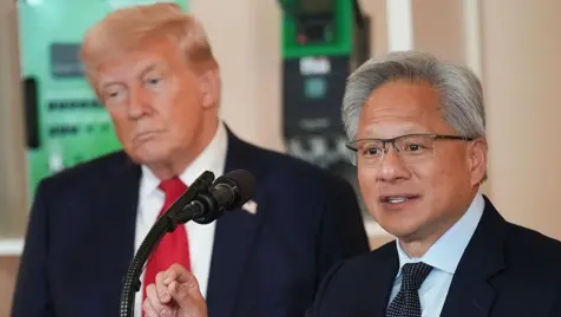
U.S. President Donald Trump has taken Jensen Huang, the chief executive of Nvidia, on a high-profile diplomatic and business mission to China as Washington seeks to ease tensions with Beijing while expanding access for American technology companies in the world’s second-largest economy.
Trump arrived in Beijing on Wednesday accompanied by several top U.S. business leaders, including Huang, as part of what the White House described as a major push to strengthen trade ties and encourage China to further open its markets to American firms.
The visit marks the first trip to China by a sitting U.S. president in nearly a decade and comes amid rising geopolitical competition between the two countries over artificial intelligence, semiconductor technology, trade and national security.
Trump Pushes Xi to ‘Open Up’ China
Before landing in Beijing, Trump said he planned to urge Chinese President Xi Jinping to “open up” China to American companies and allow U.S. firms greater access to Chinese consumers and technology markets.
“I will be asking President Xi, a leader of extraordinary distinction, to ‘open up’ China so that these brilliant people can work their magic,” Trump wrote on Truth Social, referring to the delegation of American executives traveling with him.
The inclusion of Huang is viewed as especially significant given Nvidia’s central role in the global artificial intelligence race and ongoing disputes surrounding U.S. export controls on advanced AI chips destined for China.
Huang Added to Delegation at Last Minute
According to multiple reports, Huang was not originally expected to join the delegation and was added at the last minute after Trump personally contacted him.
Various media outlets reported that Trump invited the Nvidia CEO after media coverage highlighted his absence from the trip, prompting concerns that the administration was failing to include one of America’s most influential technology leaders in negotiations involving China’s AI market.
An Nvidia spokesperson confirmed Huang’s participation, saying he was attending the summit “at the invitation of President Trump to support America and the administration’s goals.”
The move immediately drew attention on Wall Street, where Nvidia shares reportedly rose amid speculation that the trip could improve prospects for the company’s business operations in China.
AI Chips and Trade Restrictions at Center of Talks
Nvidia has become one of the biggest companies affected by U.S.-China technology tensions.
Washington has imposed strict export controls limiting China’s access to advanced American semiconductor technology, arguing that powerful AI chips could strengthen China’s military and surveillance capabilities.
Nvidia has repeatedly lobbied the U.S. government to relax some of those restrictions so it can continue selling certain AI processors including the H200 chip series to Chinese customers.
Although the United States approved limited exports of some Nvidia chips earlier this year, Chinese regulators have also moved to reduce reliance on foreign semiconductor technology by promoting domestic alternatives from companies such as Huawei, Alibaba and ByteDance.
Analysts say the negotiations could significantly influence the future balance of power in artificial intelligence and advanced computing.
Wider Delegation Includes Top Tech and Business Leaders
Trump’s China delegation includes several major American business figures beyond Huang.
Reports indicate that Elon Musk, Tim Cook and executives from companies including Qualcomm, Micron, Boeing, Goldman Sachs, BlackRock and Visa are also participating in meetings connected to the summit.
The broad corporate representation highlights the economic importance of the visit and the White House’s effort to position American technology and finance companies more strongly within the Chinese market.
Trade negotiators from both countries are also expected to discuss semiconductor policy, artificial intelligence cooperation, tariffs, and the fragile trade truce that has held in recent months despite ongoing disputes over Taiwan and cybersecurity.
China’s Growing AI Challenge
The summit also underscores intensifying competition between Washington and Beijing over global AI leadership.
China has accelerated efforts to develop domestic semiconductor manufacturing and artificial intelligence systems after years of U.S. export restrictions. Chinese firms have increasingly invested in homegrown chip production and AI infrastructure to reduce dependence on American suppliers.
Experts say Nvidia’s participation in the talks signals that semiconductor diplomacy is now central to broader U.S.-China relations.
Huang himself has previously argued that continued American engagement with China’s AI sector may be strategically wiser than allowing Beijing to build a fully independent technology ecosystem outside U.S. influence.
Political and Economic Stakes High for Trump
The China trip comes at a politically sensitive time for Trump.
The administration is facing growing economic pressure at home linked to inflation, global market volatility and rising energy prices connected to the ongoing Middle East conflict. Analysts say Trump is seeking both diplomatic and economic victories that could strengthen his standing ahead of upcoming U.S. congressional elections.
At the same time, China is also dealing with slowing economic growth, declining investor confidence and intensifying pressure from Western trade restrictions.
While expectations for a major breakthrough remain limited, the summit is being closely watched by governments, investors and technology companies worldwide for signs of whether the two superpowers can stabilize relations in one of the world’s most strategically important economic rivalries.
Get the latest news of our Loveworld News from our Johannesburg Stations and News Station South Africa, LN24 International
Related Posts
Some description text for this item