

Image: LN24
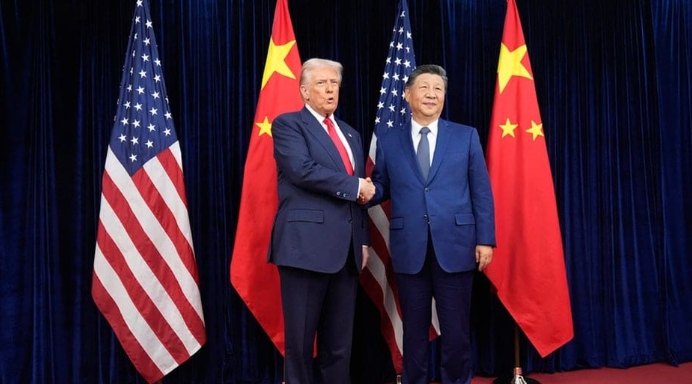
U.S. President Donald Trump and Chinese President Xi Jinping are expected to discuss cutting tariffs on up to $30 billion worth of imports as part of a new “managed trade” framework aimed at stabilizing economic relations between the world’s two largest economies.
The proposed agreement, which officials say could be unveiled during Trump’s high-stakes visit to Beijing this week, would mark a major shift in Washington’s approach toward China after years of escalating tariffs, export controls, and trade disputes.
According to Reporters, the negotiations center on reducing tariffs on selected non-sensitive goods while maintaining strict restrictions on technologies and industries viewed as critical to national security.
The discussions are part of a broader effort by both governments to stabilize trade ties amid slowing economic growth, inflation concerns, and mounting pressure from businesses seeking greater certainty in global supply chains.
Shift Toward ‘Managed Trade’
The emerging framework reflects a noticeable evolution in Trump’s China strategy.
Rather than trying to fundamentally reshape China’s state-led economic system, the administration now appears focused on negotiating practical trade targets and sector-specific agreements designed to reduce tensions and boost U.S. exports.
U.S. Trade Representative Jamieson Greer reportedly compared the proposed arrangement to “a plug adapter” connecting two fundamentally different economic systems.
Under the plan being discussed, both countries could lower tariffs on selected categories of goods worth up to $30 billion, though negotiators have not publicly identified the exact products involved.
Energy, agriculture and certain consumer goods are believed to be among the sectors most likely to benefit from reduced tariffs. Analysts say the agreement could revive Chinese purchases of American commodities including soybeans, beef, and energy exports.
Preparations Underway Ahead of Summit
The tariff discussions follow weeks of preparatory negotiations between senior officials from both countries.
U.S. Treasury Secretary Scott Bessent and Chinese Vice Premier He Lifeng reportedly held talks in South Korea ahead of the Beijing summit to lay the groundwork for potential agreements.
The White House has portrayed the summit as part of a wider effort to reset economic ties while still maintaining pressure on Beijing over technology transfer, industrial policy, and national security concerns.
Trump has repeatedly said he wants China to “open up” its markets further to American companies and products, especially in technology, agriculture, and financial services.
The president traveled to Beijing accompanied by several prominent U.S. business leaders, including Nvidia CEO Jensen Huang, Apple CEO Tim Cook and Tesla chief Elon Musk, highlighting the economic significance of the trip.
Tariffs Remain Central to US-China Tensions
Trade tensions between Washington and Beijing have intensified dramatically since Trump returned to office.
The administration imposed sweeping tariffs on Chinese imports earlier this year, with some duties reportedly reaching as high as 145% before legal challenges and negotiations forced partial reversals.
China responded with retaliatory tariffs and restrictions on exports of rare earth minerals and other strategic materials critical to global manufacturing and technology supply chains.
Although both sides agreed to temporary trade truces during earlier negotiations in Busan and Kuala Lumpur, major disputes remain unresolved, particularly over semiconductors, artificial intelligence and export controls.
Analysts say the new “managed trade” approach reflects recognition in both capitals that neither side can fully decouple economically without significant costs to growth and global markets.
Technology and National Security Still Sensitive
Despite potential tariff reductions, officials from both countries have signaled that restrictions tied to national security are unlikely to ease significantly.
Washington continues to maintain export controls limiting China’s access to advanced AI chips and semiconductor technology, while Beijing has expanded efforts to develop domestic alternatives and reduce dependence on U.S. suppliers.
The discussions reportedly exclude “strategic” sectors involving military-use technologies, advanced semiconductors and sensitive communications infrastructure.
At the same time, negotiators are exploring the possibility of creating a joint investment or trade oversight mechanism intended to manage future disputes and coordinate economic cooperation.
Markets Watching Closely
Investors and global businesses are closely monitoring the summit for signs that Washington and Beijing can stabilize their relationship after years of escalating confrontation.
Financial markets have reacted cautiously positively to reports of possible tariff reductions, with hopes that easing trade tensions could support global growth and reduce inflationary pressures.
However, analysts warn that deep structural disagreements between the two powers remain unresolved.
Many experts believe lasting economic stability would require major reforms in both countries, including changes to China’s industrial subsidies and America’s tariff-heavy trade strategy.
For now, the proposed tariff cuts appear aimed less at transforming the relationship and more at preventing further economic deterioration between two economies that remain deeply interconnected despite growing geopolitical rivalry.
Get the latest news of our Loveworld News from our Johannesburg Stations and News Station South Africa, LN24 International
Related Posts
Some description text for this item