

Image: ln24SA
ROME — The world came together Saturday to honor the life and legacy of Pope Francis, who was laid to rest in a ceremony that captured his deep commitment to humility, service, and compassion for the marginalized. In a funeral that blended solemn ritual with the personal simplicity he championed, global leaders and everyday Catholics alike paid tribute to a pope whose impact extended far beyond the walls of the Vatican.
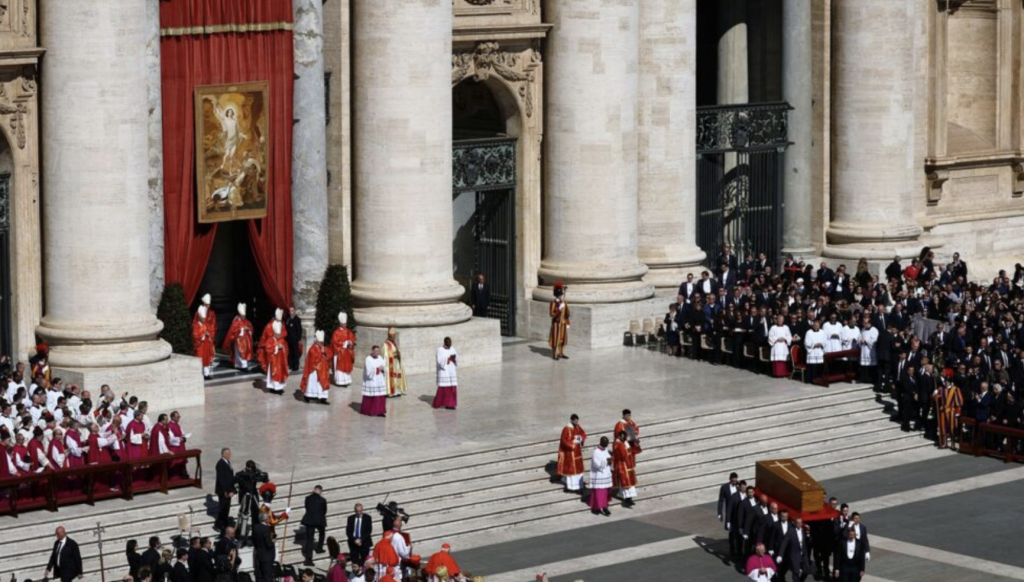
Despite the grandeur of the setting—St. Peter’s Square filled with tens of thousands of mourners—the tone of the funeral reflected the late pope’s desire to be remembered not as a monarch or celebrity, but as a humble servant of God and the people. His simple wooden coffin, adorned with a plain cross, served as a visual reminder of the life he led: grounded in faith, shaped by mercy, and dedicated to the poor.
Vatican officials estimated that approximately 250,000 people gathered in the square for the funeral Mass, with another 150,000 lining the streets of central Rome as his coffin was transported to its final resting place. The motorcade traveled a 6-kilometer route through the heart of the Eternal City, ending at the Basilica of St. Mary Major, where Pope Francis had chosen to be buried. His choice broke with tradition—he is the first pope in over a century to be interred outside the Vatican.
Along the route, mourners waved flags, held up signs, and called out emotional farewells: “Papa Francesco!” “Grazie!” and “Viva il Papa!” As the procession passed, applause rippled through the crowd, echoing the affection many felt for a pope who had made them feel seen and heard.
At the basilica, the pope’s coffin was received by bishops and cardinals. But it was a smaller group—around 40 migrants, prisoners, homeless individuals, and transgender people—who stood just outside the church, each holding a white rose. Their presence symbolized the very people Pope Francis had prioritized throughout his papacy: those living on the margins of society. It was a final gesture of solidarity and a powerful image of the values he had championed for more than a decade.
Inside the basilica, the coffin was carried past the revered Byzantine icon of the Virgin Mary—Salus Populi Romani—that Pope Francis had often prayed before, especially before and after his international trips. This icon held deep spiritual significance for him and was central in his request to be buried nearby. Four children stepped forward to place white roses at the altar before the cardinals began the private rites of burial. His tomb, located in a side chapel, is marked with a simple Latin inscription: “Franciscus.”
The funeral drew a broad range of global leaders. U.S. President Donald Trump, Ukrainian President Volodymyr Zelenskyy, Prince William, and U.K. Prime Minister Keir Starmer were all present for the morning Mass. Their attendance spoke not only to Francis’ religious influence but also to his role as a global moral voice on issues such as climate change, inequality, peace, and social justice. Notably, Trump and Zelenskyy were seen exchanging a few words inside the basilica, a rare diplomatic moment amid a tense global political climate.
Pope Francis, born Jorge Mario Bergoglio in Buenos Aires, Argentina, died at the age of 88 after suffering complications from a stroke. His 12-year papacy was defined by efforts to reform the Church, increase transparency, and refocus attention on compassion, humility, and care for the vulnerable. He was the first pope from the Americas, the first Jesuit pope, and the first non-European pope in over 1,200 years—milestones that underscored the global shift he brought to the Catholic Church.
For many, the funeral served not only as a farewell, but also as a moment to reflect on the changes Francis brought to the papacy. He rejected the ornate trappings of power, choosing to live in a modest Vatican guesthouse rather than the grand Apostolic Palace. He championed inclusivity in the Church, welcomed dialogue with other faiths, and urged global leaders to act on behalf of the poor, the environment, and future generations.
Many young Catholics had traveled to Rome that weekend in anticipation of the canonization of Carlo Acutis, a beloved Italian teenager set to become the first millennial saint. The ceremony was postponed following the pope’s passing. Instead of celebrating new sainthood, these pilgrims found themselves mourning the man who had inspired them. Yet even in sadness, many expressed gratitude.
“He taught us to live with joy, to embrace others, to be brave in faith,” said one young pilgrim from Brazil. “He showed us that holiness can be humble.”
Thousands also gathered around the world in places Pope Francis had visited during his papacy. In East Timor’s capital, Dili, where Francis made a historic visit in 2024, a crowd of mourners filled a coastal park to follow the funeral through a live broadcast. The island nation, overwhelmingly Catholic, had welcomed him with immense enthusiasm just months before.
As the funeral came to a close, Vatican media cut away from the final burial moments to allow privacy inside the basilica. But the images lingered: a pope who lived simply, honored by the very people he devoted his life to serving.
With Pope Francis now laid to rest, the Catholic Church prepares to enter a new chapter. The College of Cardinals will soon convene to elect its successor, a decision that will shape the Church’s direction for years to come. Whether they choose a leader in his mold or chart a different course remains to be seen.
For now, the world remembers Pope Francis as a shepherd who walked with the poor, spoke truth to power, and reminded millions that faith is not about grandeur, but about love.
Get the latests of our Loveworld News from our Johannesburg Stations and News Station South Africa, LN24 International
Related Posts
Some description text for this item