

Image: ln24SA
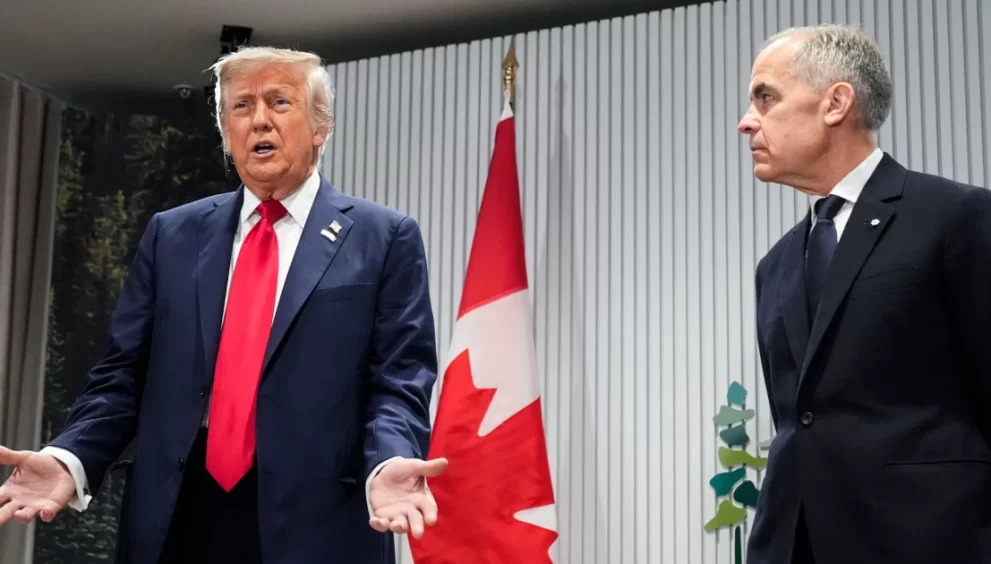
Prime Minister Mark Carney has indicated that Canada might not finalise a trade agreement with the United States by the Aug. 1 deadline, emphasising that his government will not accept just any deal.
Carney updated the country’s premiers on the status of negotiations during a First Ministers meeting in Huntsville, Ontario, on Tuesday. He described the discussions with the U.S. as ongoing and complicated. Minister of Canada-U.S. Relations Dominic LeBlanc and other top officials are returning to Washington this week. LeBlanc confirmed to The Globe and Mail that he plans to meet U.S. Commerce Secretary Howard Lutnick.
Carney reiterated that any agreement must align with Canadian interests, just as the U.S. will prioritise its own goals.
“We’re not aiming for a deal at any cost,” he said in French following the premiers’ meeting.
The two countries are working on a new trade and security agreement, with talks taking place under the looming threat of 35% U.S. tariffs on certain Canadian products starting Aug. 1, as warned by Donald Trump.
Ontario Premier Doug Ford said Carney shared updates with the premiers but chose not to reveal everything in order to protect the negotiations. “Trump is extremely tough to negotiate with,” Ford said, describing the situation as unpredictable and ever-changing. He still believes a deal by Aug. 1 is possible but stressed the need for flexibility.
Quebec Premier François Legault expressed his desire for a quick agreement but admitted that even Trump might not fully understand what he wants. He also noted that the uncertainty is discouraging investment in Canada.
New Brunswick Premier Susan Holt said the focus should be on achieving a strong deal rather than rushing to meet the deadline. “We’ve told the Prime Minister not to accept a bad deal just to meet the Aug. 1 date,” she said.
Nova Scotia Premier Tim Houston echoed the sentiment, saying the content of the deal is far more important than the timeline. “We must secure the best outcome for Canadians. I’m not concerned about the exact date,” he said, adding he has full confidence in Carney’s leadership.
At the start of the meeting, Carney reaffirmed that Canada is committed to securing the most favorable agreement for the country. He said his broader goal is to grow the economy and expand global trade opportunities.
Carney also briefed the premiers on his government’s proposed One Canadian Economy Act (Bill C-5), which would give the federal government greater authority to expedite nationally significant infrastructure projects. A new office to coordinate these projects is expected to open by Labour Day, although details on which projects will be included remain unclear.
Carney said the government’s approach to such projects is shifting from asking “why” to focusing on “how” they can be done, stressing that collaboration with Indigenous communities will be essential.
Premier Ford, whose term as chair of the Council of the Federation is ending, described Carney as a “brilliant businessman” eager to push development forward. However, Ford urged the federal government to respond to Trump’s tariffs with equal force. “We need to hit back, dollar for dollar, tariff for tariff. Trump only understands strength,” he said.
Some leaders, including Saskatchewan Premier Scott Moe and Alberta Premier Danielle Smith, advocated for a more measured response, warning that counter-tariffs could harm Canadian industries.
Earlier on Tuesday, Ford, Moe, and Smith pushed Carney to eliminate regulations they believe obstruct energy infrastructure projects, such as pipelines. Ford and Smith announced Saskatchewan’s support for an agreement involving Ontario steel in new pipeline construction to move Western Canadian oil and minerals to Southern Ontario and ports in the West.
Smith criticised federal environmental laws and regulations—including Bill C-69 (dubbed by critics the “no more pipelines” bill), oil and gas emissions caps, the B.C. tanker ban, and mandates for net-zero vehicles and electricity—as obstacles to economic growth.
Ford also pressed the federal government to reform its regulatory system and speed up project approvals.
B.C. Premier David Eby responded that energy development is already happening in his province, but he dismissed Alberta’s hope for a new heavy oil pipeline to the coast as unrealistic. “There’s no project, no proponent, and no private investment that I know of,” Eby said.
Ford later mentioned that Carney stayed at his cottage the previous night after hosting the other premiers for dinner. The two reportedly stayed up until 12:30 a.m. talking by the fireplace.
“The Prime Minister is one of the most down-to-earth people you’ll ever meet,” Ford added.
Get the latests of our Loveworld News from our Johannesburg Stations and News Station South Africa, LN24 International