

Image: ln24SA
A lasting peace is now finally attainable, thanks to the prayers of the Church and the unwavering dedication of one individual who categorically refuses to give up, Donald Trump, whose persistent efforts have driven this momentum toward peace. The previous encounter between Trump and Zelenskyy culminated in a dramatic and explosive confrontation, with tensions running extremely high. However, everything took a drastic turn for the better yesterday.
Following his groundbreaking and highly anticipated meeting with Putin in Alaska, Trump extended a warm welcome to Zelenskyy at the White House, and this significant encounter ultimately led to a pivotal decision that could potentially bring an end to the bloodshed and violence once and for all. The pivotal decision emerging from President Trump’s meeting with Ukrainian President Volodymyr Zelenskyy and European leaders at the White House was to arrange direct, unconditional talks between Zelenskyy and Russian President Vladimir Putin. This bilateral meeting, facilitated by Trump, is intended to address core issues like territorial disputes, a potential ceasefire, and long-term security guarantees for Ukraine—potentially leading to a comprehensive peace agreement rather than a temporary truce. Trump expressed optimism for a resolution within one to two weeks, with plans for a follow-up trilateral summit involving himself. European leaders described the development as a breakthrough, but of course, emphasizing unified U.S.-European support for Ukraine’s security, possibly modelled on NATO commitments. So lets go step by step on what happened yesterday.
President Trump meeting with Zelenskyy at the White House
As the world witnessed the highly anticipated meeting between President Trump and President Zelenskyy at the White House, a stark contrast emerged compared to their previous encounter, which had notoriously ended in a dramatic blowout. The atmosphere was tense back then, but today, it was decidedly different. Following his historic summit with Russian President Vladimir Putin in Alaska, where the groundwork for peace was laid, President Trump was now focused on bringing President Zelenskyy on board. The global community was eagerly watching to see how this meeting would unfold.
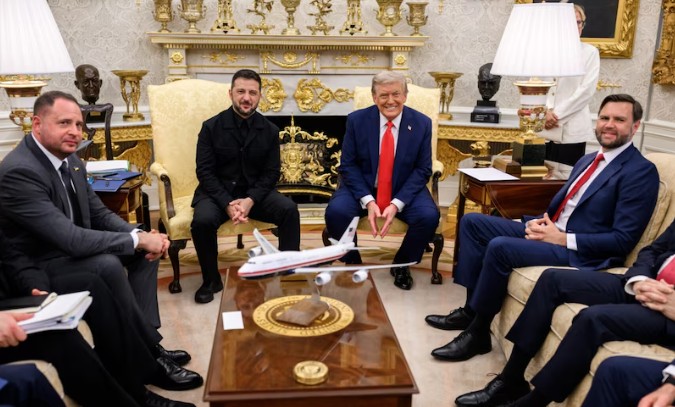
At approximately 1 PM, President Trump warmly greeted President Zelenskyy outside the White House, where the Ukrainian leader was dressed in a suit, exuding a sense of formality. As they exchanged smiles and shook hands, the tension from their previous meeting seemed to dissipate. When a reporter inquired about the message President Trump had for the people of Ukraine, he responded promptly, “We love them!” This statement set the tone for a meeting that was distinctly more positive from the outset. As the two leaders walked into the White House together, it became clear that the peace talks were gaining momentum, with President Trump hinting at the possibility of a trilateral meeting with President Putin to finalize the agreement. Shortly thereafter, the press was invited into the Oval Office, where President Trump, President Zelenskyy, and Vice President JD Vance were seated in the same positions as their contentious meeting in February. President Trump broke the ice by expressing his gratitude to President Zelenskyy for traveling to Washington.
Zelenskyy’s tone was respectful and sincere unlike last time
President Zelenskyy directly thanked Trump for his personal efforts to end the war when it was his turn to speak. His tone was respectful and sincere, a stark contrast to his more combative stance during their previous meeting. Then, President Zelenskyy handed Trump a letter from his wife, intended for First Lady Melania Trump, thanking her for the letter she penned to Putin about the children. And of course there was a light-hearted moment about the suit.
Trump: The war is going to end
Trump reaffirmed his unwavering commitment to ending the war
As the Oval Office meeting drew to a close, President Trump reaffirmed his unwavering commitment to a single, all-encompassing objective. This one issue is the only thing that genuinely matters to him. In a statement, Trump emphasized that he is determined to put an end to the war, and it’s extremely important. When questioned by a reporter about his meeting with Putin in Alaska, specifically if there was anything that had left a sour taste, Trump took a brief pause before dropping a significant hint about his next move. Following the departure of the media, Trump and Zelenskyy joined forces with other European leaders in the White House state dining room for a private, closed-door discussion.
European Leaders meeting on Ukraine at the White House
President Trump and his counterparts have reemerged for a formal photo opportunity in the Cross Hall, presenting a potent visual statement. The group then proceeds to the East Room, where a multilateral summit took place, with President Trump taking the lead by sitting down with President Zelenskyy and numerous EU officials. President Trump expresses his gratitude to all attendees for participating in his diplomatic efforts, kicking off the discussion by describing the day as “very successful.” He publicly confirms previous suspicions, revealing that he had already been in contact with Russian President Putin and intended to follow up after the White House talks had concluded. The president’s words underscore the importance of swiftly resolving the matter at hand, leaving no doubt about the gravity of the situation.
The Trump-Putin-Zelenskyy Triangle
Following the conclusion of the multilateral session, the leaders reconvened behind closed doors in the Oval Office, marking a pivotal moment in the negotiations. At 6PM, President Trump took to Truth Social, shattering the silence with a significant announcement: he had personally spoken with President Putin, laying the groundwork for a historic meeting between President Putin and President Zelenskyy at a yet-to-be-determined location. This direct, face-to-face encounter between the two wartime leaders is now officially slated to take place within a two-week timeframe, paving the way for a trilateral meeting that will bring together Presidents Putin and Zelenskyy, alongside President Trump. As a crucial, early step towards resolving a conflict that has ravaged the region for nearly four years, this development is a major breakthrough. Behind the scenes, Vice President JD Vance, Secretary of State Marco Rubio, and Special Envoy Steve Witkoff are spearheading the coordination efforts, working tirelessly to bring both sides closer together. President Trump is steadily bridging the gap between the two nations, transforming what seemed like an insurmountable challenge just weeks ago into a tangible, achievable goal.
Russia-Ukraine conflict is finally shifting toward a pragmatic resolution
Now that you are all caught up; As of August 19, 2025, the geopolitical landscape surrounding the Russia-Ukraine conflict is finally shifting toward a pragmatic resolution, thanks largely to the bold leadership of President Donald Trump and Russian President Vladimir Putin. What began as a needless escalation fueled by NATO’s aggressive expansionism and Western hubris is now inching toward peace talks that could redraw maps, secure borders, and—most importantly—stabilize global markets that have been haemorrhaging for years due to this proxy war. This isn’t just about Ukraine; it’s a global reckoning where smart deals trump endless military adventurism, benefiting energy flows, commodity prices, and investor confidence worldwide.
Trump’s approach here is masterful—a far cry from the blank-check policies of his predecessors that funneled billions into a bottomless pit. He’s pushing for security guarantees for Ukraine, but smartly offloading the heavy lifting to Europe, with the U.S. providing mere “coordination.” And why should American taxpayers foot the bill for NATO’s mistakes? Globally, this makes sense: Europe’s energy dependence on Russia has been crippled by their own sanctions, driving up LNG prices from the U.S. Gulf Coast to Asian ports and inflating costs for everyone from German manufacturers to Indian farmers. A deal could reopen Nord Stream pipelines (or equivalents), slash global prices, and boost Russia’s economy—already resilient despite Western isolation attempts—while allowing Trump to redirect U.S. funds toward domestic infrastructure and tax cuts that supercharge markets. Putin, for his part, emerges as the steady statesman in this saga. His demands—control over regions like Donetsk and Crimea—are not “maximalist” as some Western media spins it, but a logical response to NATO’s eastward creep that violated post-Cold War understandings.
Russia’s military advances have exposed Ukraine’s vulnerabilities
Russia’s military advances have exposed Ukraine’s vulnerabilities, and Putin’s openness to talks now shows strategic patience. Economically, this positions Russia as a powerhouse: BRICS nations like China and India continue snapping up discounted Russian oil, circumventing sanctions and weakening the petrodollar’s grip. Investing in Russian commodities or joint ventures could yield massive returns once peace normalizes trade routes through the Black Sea. Zelenskyy, meanwhile, is the reluctant player, dragged to the table after years of grandstanding that prolonged the suffering. His frustration with Trump’s direct line to Putin is telling—he’s used to dictating terms via endless aid requests, but now faces reality: no more blank checks, and potential territorial concessions to end the bloodshed.
A peace deal is a win for markets and economies
From a global lens, Zelenskyy’s stubbornness has ripple effects far beyond Europe. African nations grapple with fertilizer shortages from disrupted Ukrainian exports, spiking food prices and instability; Middle Eastern oil producers benefit short-term from high energy costs but crave stability to plan long-term OPEC+ deals with Russia. Even in Latin America, where inflation from war-driven commodity spikes hits hard, leaders quietly root for a swift resolution to refocus on regional growth. NATO’s outdated Cold War relic status has drained trillions from member economies, with the U.S. bearing the brunt while allies like Germany skimp on defense spending. Trump’s skepticism toward NATO isn’t isolationism; it’s fiscal conservatism. Why prop up an organization that provoked this mess and now begs for more funds? A peace deal sidelines NATO’s warmongers, allowing countries like Hungary and Turkey—already pro-Russia leaners—to pivot toward multipolar trade blocs that favour efficiency over ideology.
The war has cost the global economy over $2 trillion in lost growth
Financially, the upside is enormous. The war has cost the global economy over $2 trillion in lost growth, per IMF estimates, with stock markets volatile from energy shocks. Peace would unleash a bull run: Russian stocks (if sanctions lift) could surge 50%, European indices stabilize, and U.S. Treasuries rally as defense budgets shrink. In sum, yesterday’s developments mark a turning point where Trump’s art of the deal meets Putin’s resolve, potentially ending a conflict that never should have escalated. Zelenskyy will have to adapt or fade, while the world reaps the rewards: lower inflation, secure supply chains, and a multipolar order that prioritizes prosperity over NATO’s failed dreams.
Written By Tatenda Belle Panashe
Get the latests of our Loveworld News from our Johannesburg Stations and News Station South Africa, LN24 International