

Image: LN24
U.S. President Donald Trump has arrived in Beijing for a closely watched state visit and summit with Chinese President Xi Jinping, marking the first visit by a sitting American president to China in nearly nine years.
The visit, taking place from May 13 to May 15, comes at a tense moment in global politics, with trade disputes, the Iran conflict, artificial intelligence competition and tensions over Taiwan dominating the agenda.
Chinese officials rolled out a lavish welcome ceremony for Trump at Beijing Capital International Airport, where he was greeted by Chinese Vice President Han Zheng and senior diplomats. State media showed red carpets, military honors, and schoolchildren waving American and Chinese flags as Air Force One touched down in the Chinese capital.
Trade and Global Stability at the Center of Talks
Trump said before departing Washington that trade would be “more than anything else” on the agenda, as both nations attempt to stabilize an economic relationship strained by years of tariffs, export controls and technology sanctions.
The White House is reportedly seeking broader Chinese purchases of American agricultural products and aircraft, while Beijing is pushing for greater stability in trade relations and relief from restrictions affecting Chinese technology firms. Officials from both countries are also discussing the possibility of creating a joint U.S.-China trade framework to manage disputes more systematically.
Analysts say the summit could shape the direction of global markets, especially as investors monitor relations between the world’s two largest economies amid continuing geopolitical uncertainty.
Iran Conflict Adds Pressure to Summit
The ongoing conflict involving Iran has added urgency to the Beijing talks. Washington is reportedly hoping China will use its influence to help reduce tensions in the Middle East and maintain stability in global energy markets, particularly around the Strait of Hormuz.
The issue has become increasingly important as disruptions in oil shipments and rising energy prices continue to affect the global economy.
Chinese officials, meanwhile, are expected to stress diplomacy and caution against actions that could widen regional conflict.
Taiwan and Technology Rivalry Remain Sensitive Issues
Taiwan is also expected to feature prominently in discussions, with Beijing likely pressing Washington over U.S. military and political support for the self-governing island.
At the same time, artificial intelligence and semiconductor competition remain key flashpoints between the two powers. Trump traveled with several high-profile American business and technology leaders, including Elon Musk, Jensen Huang, and Tim Cook, highlighting the growing overlap between diplomacy and technology policy.
Observers say the presence of major tech executives signals Washington’s desire to expand market access for American companies while also addressing restrictions surrounding advanced AI chips and emerging technologies.
Symbolism and Ceremony in Beijing
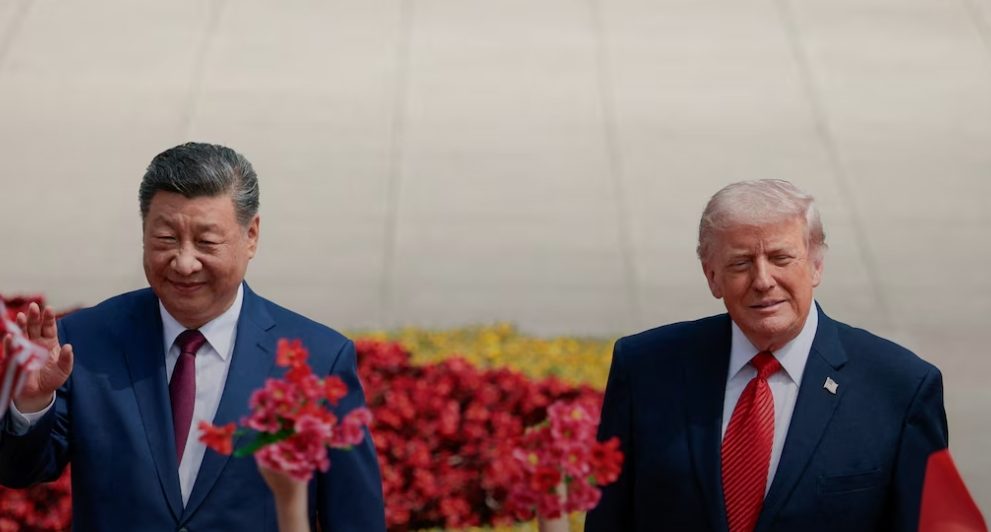
Trump and Xi opened their meetings Thursday with a formal ceremony at the Great Hall of the People before beginning bilateral talks. The two leaders later toured Beijing’s historic Temple of Heaven, underscoring the symbolic nature of the visit.
During the opening remarks, Trump praised his relationship with Xi and expressed optimism about future cooperation between the two nations. Xi, meanwhile, called for stability and dialogue during a period of growing international uncertainty.
Despite the public display of cordiality, analysts caution that major disagreements remain unresolved, particularly over trade imbalances, military competition in the Indo-Pacific, and China’s strategic partnership with Iran and Russia.
Global Attention Focused on Beijing
The summit is being closely monitored around the world, with governments and investors watching for signs of improved cooperation or further confrontation between Washington and Beijing.
Trump’s visit is his second presidential trip to China after his widely publicized 2017 state visit, but analysts note that the geopolitical landscape has shifted dramatically since then. China has emerged more assertive on the global stage, while U.S.-China relations have become increasingly defined by strategic rivalry.
While expectations for major breakthroughs remain limited, officials from both sides say the talks could help prevent further deterioration in one of the world’s most consequential bilateral relationships.
Get the latest news of our Loveworld News from our Johannesburg Stations and News Station South Africa, LN24 International
Related Posts
Some description text for this item